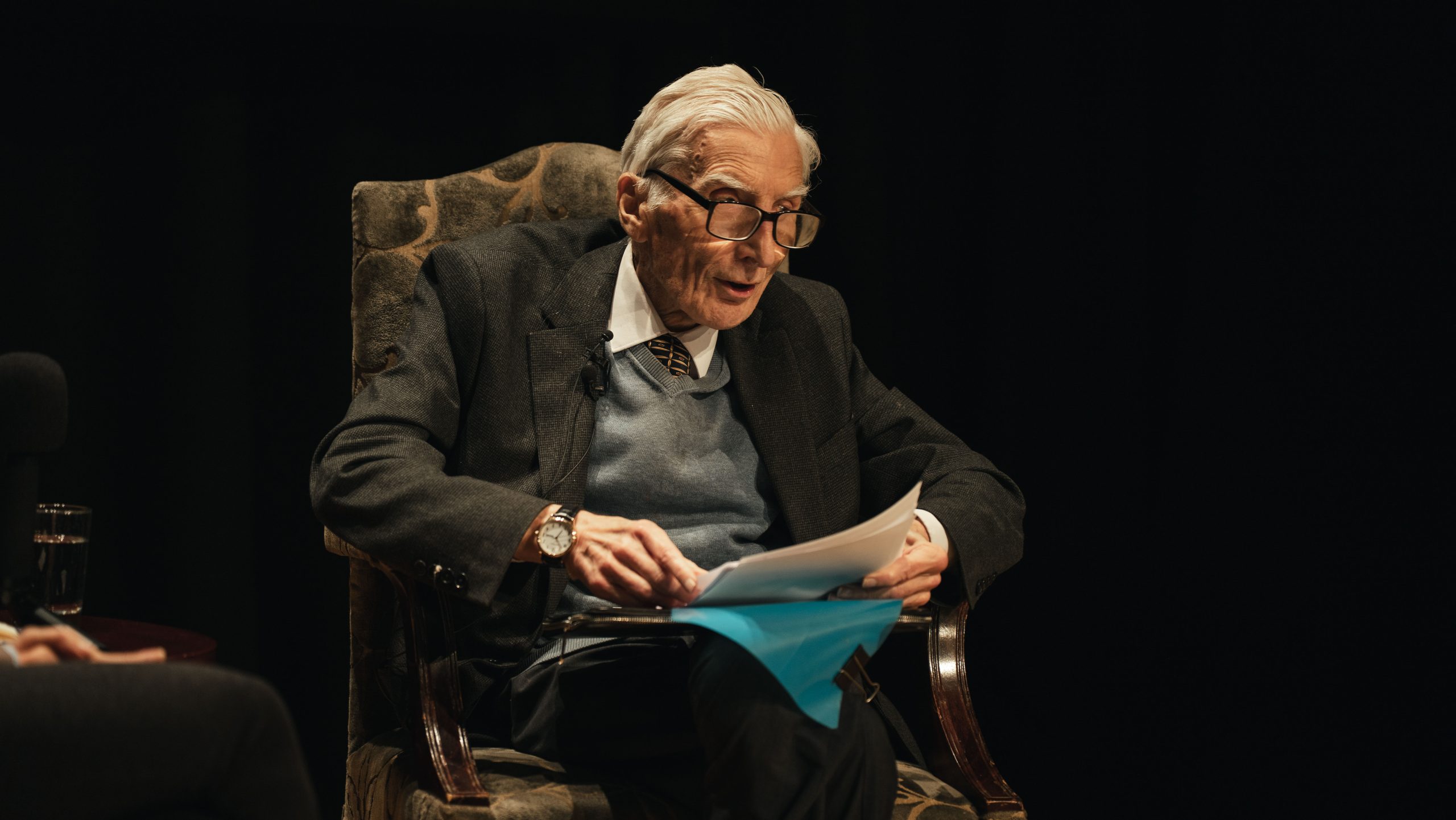
2 December 2025, Sidney Sussex College, Cambridge
The University of Cambridge Better Futures Programme welcomed Leaders and guests to Sidney Sussex College for an evening focused on exploring how genomics is reshaping medicine, research, and our understanding of ourselves. The conversation was excellently chaired by Prof Patrick Maxwell (Regius Professor of Physic, University of Cambridge) with fantastic guest speakers Prof Matthew Hurles (Director, Wellcome Sanger Institute) and Prof Mina Ryten (Professor of Neuroscience and Director, UK Dementia Research Institute at Cambridge),
While genomics has given us unprecedented tools to understand human biology, the speakers emphasised from the outset that the impact of these tools depends entirely on how we choose to use them: with openness or with restriction, with patients or apart from them, with humility or false certainty.
Prof Patrick Maxwell opened the evening by situating genomics within Cambridge’s scientific story. The first genome was sequenced here in the 1970s – a modest 3,000 letters of genetic code that nonetheless won Fred Sanger a Nobel Prize. Half a century later, the Sanger Institute that bears his name has helped decode the three billion letters of the human genome, and sequencing costs have fallen from billions of dollars to a few hundred. As Patrick noted, what once demanded thousands of scientists and years of effort is now technically routine: “It is pretty trivial from a technical point of view to read a whole human genome.”
Yet the evening made clear that the true revolution is not technical but human: what this new capacity means for patients, families, clinicians, and societies.
“…And now people have come up with ways of developing new codes and new amino acids… we will be able to experiment in spaces that nature has never been able to experiment in.” – Prof Patrick Maxwell
Prof Mina Ryten began by describing her dual role as clinical geneticist and neuroscientist. In clinic, she sees patients when there is a suspicion of an inherited condition; in the lab, her team connects genetic variation and RNA “readouts” from brain tissue to mechanisms of neurodegenerative disease. For her, modern genomics is not an abstract promise but the everyday basis of diagnosis.
She emphasised that even when no treatment exists, the impact of a genetic diagnosis is profound. Parents of children with severe conditions, she explained, often carry a silent burden of self-blame, replaying pregnancy and early life for something they might have done “wrong”. A clear genetic cause can release that weight, inform decisions about future pregnancies, and connect families with others facing the same condition.

“People need to know why they are the way they are… even when it doesn’t change treatment, they actually care about knowing the cause.” – Prof Mina Ryten
Matt then set this clinical experience within the broader landscape of population and rare disease genomics. As Director of the Sanger Institute, he oversees programmes that stretch from the genetics of neurodevelopmental disorders to biodiversity and “engineering genomics”. One of his earlier flagship projects, Deciphering Developmental Disorders (DDD), recruited around 14,000 families across the UK and Ireland whose children had severe, unexplained developmental conditions.
By sequencing not only the child but also both parents, the team showed that in many cases the underlying cause was a new mutation arising in the egg or sperm – a change the child carries but neither parent does. This insight has transformed counselling. Rather than offering broad recurrence risks of “10–15%” in the absence of a diagnosis, clinicians can now often reassure parents that the chance of having another affected child is very low.
Genomics has, in other words, shifted the bottleneck. Sequencing is no longer the limiting factor; interpretation is. While thousands of families have received clear answers, an increasing number fall into a grey zone of “variants of uncertain significance”: genetic differences whose role in disease is not yet understood. Addressing that new bottleneck – through larger datasets, better models, and international collaboration – is now one of the field’s central challenges.

“Our ability to sequence DNA has gone vastly ahead of our ability to interpret it.” – Prof Matthew Hurles
The discussion then turned to scale and openness. The Human Genome Project pioneered a model of large, international science that is both collaborative and radically open: data released nightly and made freely available to the world. Sanger’s contribution to roughly 40% of the reference genome helped set a precedent that the human genetic code should be held “in common” rather than locked up behind patents.
That ethos continues to matter. New studies now involve hundreds of thousands of participants across multiple countries. For rare diseases in particular, discoveries often depend on being able to find the one other family with the same ultra-rare variant – sometimes in another region or on another continent. Nationalistic approaches to data that prevent DNA leaving a jurisdiction, or aggressive patent strategies that lock up therapeutic approaches across hundreds of genes, risk slowing or distorting this progress.
At the same time, the speakers acknowledged real concerns around biosecurity and equity. Fears about “genetically targeted” bioweapons have fed calls in some countries to restrict the sharing of genomic data. Here, Matt’s background in population genetics was grounded: humans, he noted, are a remarkably young and homogeneous species; on average, 999 out of every 1,000 letters of DNA are the same between two people. Most common genetic variants are shared across populations, making precisely targeted attacks much harder than popular narratives suggest.
Rather than retreating from openness, he argued, the answer lies in better literacy about what genetic data can – and cannot – enable, combined with fairer models of partnership that build analytic capacity in countries contributing data.

Questions from the audience steered the conversation towards ethics and identity. If your genome is sequenced today, who, if anyone, has a duty to re-contact you as knowledge evolves? Should clinicians disclose unrelated risks discovered incidentally – such as predisposition to early-onset Alzheimer’s?
Mina and Matt both emphasised that medicine is now at a turning point. Historically, patients approached clinicians with a specific concern, and the clinician’s role was to address that issue. Whole-genome sequencing alters that model: as Mina explained, “You might come to me feeling well, and I tell you you’re at risk of X, Y and Z that you never asked about.” Some patients want this information; others explicitly do not. Genomics will therefore require new frameworks for consent, re-analysis, and the communication of uncertain risk.
The evening closed with a sense of cautious optimism. Cambridge’s role in the story of genomics – from Sanger’s first sequencing methods to today’s vast, collaborative efforts – has helped create tools that can transform lives. But the tools alone are not enough. Genomic data are not neutral: how they are interpreted, which conditions are prioritised, and whose voices shape research agendas will all influence whether this revolution deepens dignity and agency, or exacerbates existing inequities. Real progress depends on how we choose to use these capabilities—in partnership with patients and communities, and with humility about what we still do not know.
A huge thank you to Sidney Sussex College and Professor Martin Burton for hosting such a rich and thought-provoking dinner, to Prof Patrick Maxwell for leading the discussion, and to our speakers Prof Matthew Hurles and Prof Mina Ryten for their generous, insightful contributions.